What's new

Release notes and product updates from Vee3.

Domain metrics moves to the SEO group

Domain metrics is now part of the SEO group instead of Domains. You will find it with the other SEO tools in the catalog, docs, and Customize MCP toggles.

What stays the same

Agents and API clients keep using the same identifiers:

  • MCP tool: domains.metrics
  • REST: GET /v1/domains/metrics
  • Capability id: domains-metrics
  • Cost: 40 tokens

Docs

The docs page is now at /docs/seo/domains-metrics.

Domain registration and managed DNS

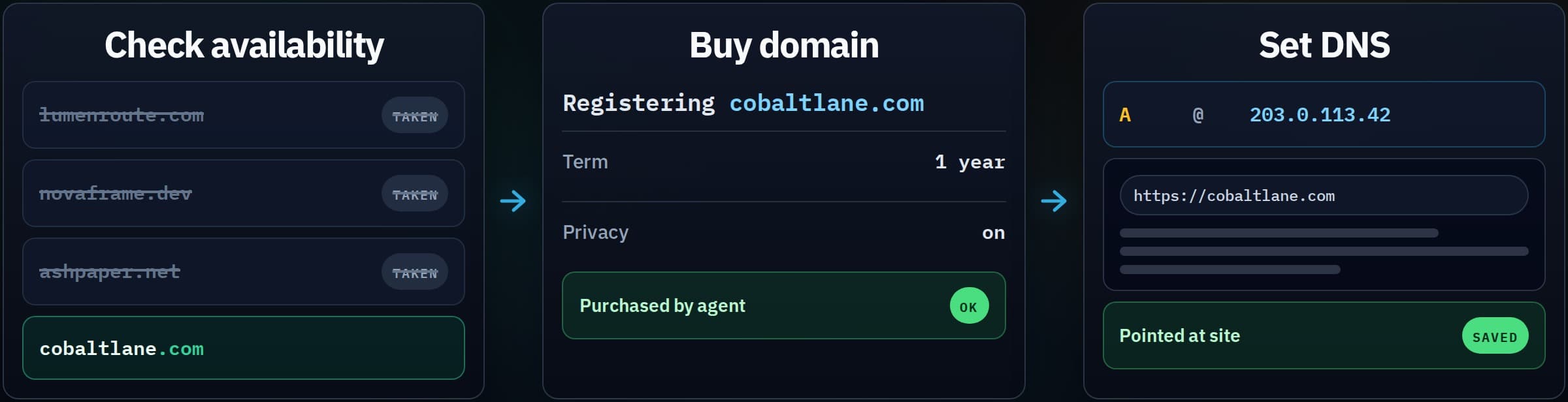
Agents can now buy and manage domains through Vee3: check whether a name is available to purchase, get a token quote, register it, renew it later, and edit DNS host records one at a time.

Domain registration workflow

Register and renew

Registration and renewal use platform credentials and Vee3 token billing. Agents do not need a separate registrar account.

Flow for a new name:

  1. domains.check_availability to see if Vee3 can sell it
  2. domains.registration_quote for the token cost
  3. domains.register with registrant contact details and the quoted expected_token_cost

Use a real registrant email the domain owner can access. The registrar may send a verification email that must be completed.

For domains already managed on the account, domains.renewal_quote then domains.renew extend the term.

Pricing

Quoted costs are plan-aware and token-only:

Managed domains and DNS

After registration, the domain appears under managed domains. Agents can list and inspect it, then manage DNS host records without replacing the whole zone:

Docs

Secrets and Claude connector

API Keys now has a Secrets section for client ID and client secret pairs. Use them with Claude: add a custom connector pointing at https://mcp.vee3.io/mcp, then paste the credentials under Advanced.

Guide: Connect Vee3 MCP to Claude

Agent files: upload, download, and manage storage

File handling for agents is now a first-class Files group. Upload and list tools live under files.* (no longer under Meta tools), and agents can download, move, delete, and extend retention the same way.

Tools

Agents install the CLI once with npm install -g @vee3/cli, then run vee3-upload and vee3-get-file with the codes those tools return.

Retention and pricing

Uploads take an optional retention_days (default 7, max 90). Cost is based on size and how long the file is kept. List responses include retained_until; agents use files.extend_file to keep a file longer.

Getting files onto disk

When a tool returns a download_code, the agent runs:

vee3-get-file {download_code} ./path/to/save

That applies to uploaded files and to tools that write into account storage, including website screenshots and TikTok video/music downloads (a signed URL is still included for API-only use). Optional file_name sets the storage path; otherwise files land under downloads/.

TikTok video quality

tiktok.download_video uses quality: standard (default) or hd. One quality per call.

Docs

Clerk integration

Agents can now work against your own Clerk instance through Vee3: your application and your data, not a shared sandbox.

Connect Clerk

Connect a Clerk application from Connections at app.vee3.io/dashboard/connections.

What ships today

The Clerk capability group includes 199 MCP tools covering:

  • Users: list, create, update, ban, metadata, email and phone numbers, OAuth accounts, MFA, and passkeys
  • Organizations: CRUD, memberships, invitations, domains, and RBAC (roles, permissions, role sets)
  • Sessions and sign-in: sessions, sign-in tokens, actor tokens, and client verification
  • Billing: plans, prices, subscriptions, statements, and credit balances
  • Machines and API keys: M2M tokens, machine scopes, and API key lifecycle
  • Webhooks: Svix app setup and dashboard links
  • Instance config: domains, redirect URLs, JWT templates, OAuth applications, enterprise SSO, allowlist/blocklist, and waitlist

Use Customize MCP to turn the Clerk group on or off for your server.

Start here

Call meta-tools.search with a task like "invite user to Clerk organization" or meta-tools.list_group_tools with clerk to browse the full catalog.

Docs

Lower X read pricing

X read tools are cheaper today. If your agents search posts, pull timelines, or look up profiles, the same workflows cost fewer tokens.

New prices

Docs

Customize MCP

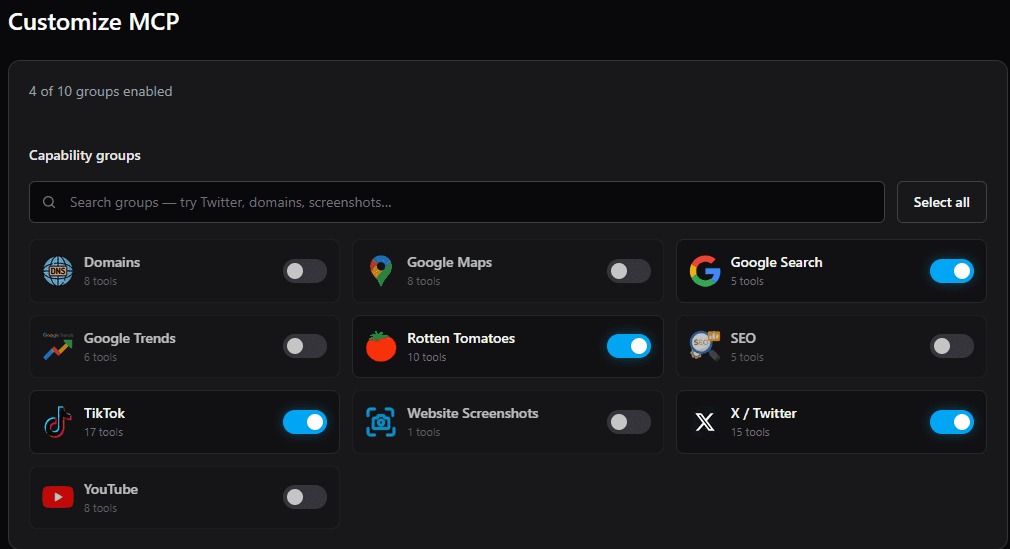
Open Customize MCP at app.vee3.io/dashboard/customize-mcp.

Customize MCP dashboard

Each capability group is a card with an on/off switch. Turn groups off to keep them off your MCP server; turn them back on anytime.

Use the search bar to filter groups by name or keyword (for example twitter, whois, or screenshots).

Connected accounts and post on X

Connected accounts

Connect X (Twitter) accounts from the dashboard at Connections (app.vee3.io/dashboard/connections).

Publish to X

The X / Twitter capability group now includes official write support for connected accounts, alongside the existing read APIs.

Create X post supports text, polls, media attachments, reply settings, and other X post options. Call get-x-connected-accounts first to pick an account. If no accounts are connected, the user must connect at https://vee3.io/dashboard/connections — agents cannot complete OAuth.

Pricing: 60 tokens for a text post. Posts where X shortens a link to t.co in the response are billed at 1,000 tokens base instead. Images add 50 tokens each; videos add 150 tokens plus 50 tokens per 5 MB. Failed posts are not billed.

Docs

Agent file uploads

Large files no longer need to travel through MCP as base64.

How it works

  1. Call files.upload_file with a desired file_name to get an upload code.
  2. Install the CLI once: npm install -g @vee3/upload
  3. Run vee3-upload {upload_code} {file_path} in a terminal.
  4. Call files.list_uploaded_files to see stored files and reference them in follow-up calls (for example, media on an X post).

Files can be up to 2 GB and are kept for 14 days. Storage is billed after upload at 1 token per 20 MiB.

Docs

Report bugs from agents

Agents can now report unexpected failures with meta-tools.report_bug (0 tokens).

Include a short summary, a detailed description, and optionally the related capability id. Reports are free and do not consume token quota.

Docs